

…in ambitious new strategy
…as it seeks to drive industrial transformation and economic growth
Leemisa Thuseho
THE Lesotho National Development Corporation (LNDC) has set an ambitious target of creating 50 000 jobs by 2031 under its newly launched 2026–2031 strategic plan, which aims to transform the economy, expand employment, diversify production and strengthen Lesotho’s long-term economic resilience.
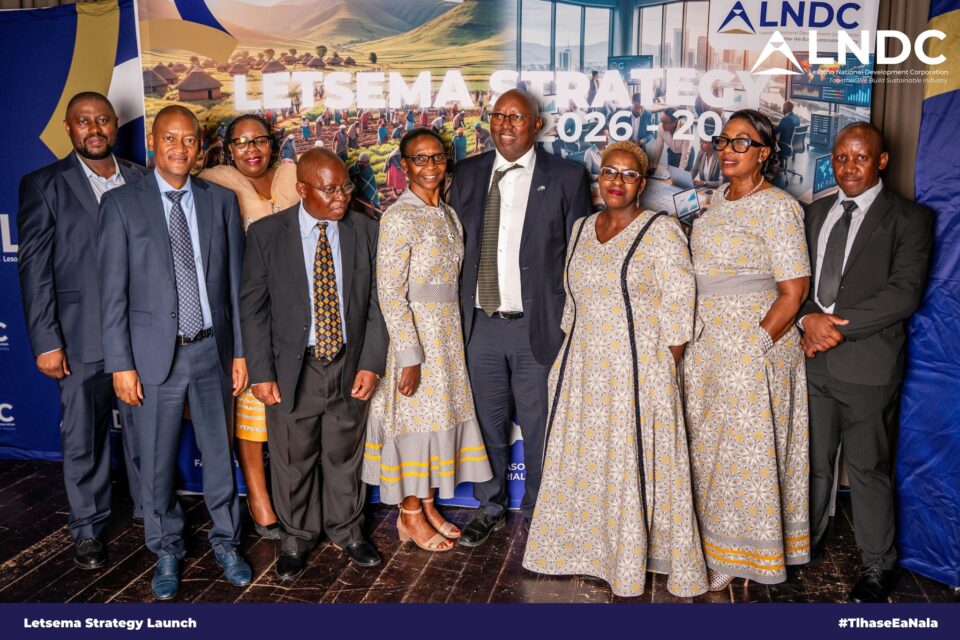
The plan, dubbed the Letsema Strategy 2026–2031, was officially launched this past week at Avani Maseru.
Presenting the strategy, LNDC Chief Executive Officer, Thabo Khasipe, said the plan had been designed to improve the standard of living for Basotho and reposition the country on a stronger development trajectory.
“The higher purpose of the strategy is to improve the standard of living of a Mosotho,” Mr Khasipe said.
He said LNDC had identified five key outcomes that would define its success by March 2031, including the creation of 50 000 net new jobs directly facilitated by the Corporation.
“We want to create over the next five years 50 000 new net jobs. We have a clear trajectory for how these jobs will be delivered. We may lose some jobs along the way and gain others, but by the end of this period we must have 50 000 new jobs,” he said.
The strategy also targets seven percent growth in nominal GDP per capita, as well as the creation of 100 new Basotho industrialists, each employing at least 100 people.
“We want to create 100 new Basotho industrialists. These are individuals who do not exist today, and we define them as people employing at least 100 people,” Mr Khasipe said.
By 2031, LNDC also aims to develop five new industrial sectors and achieve the highest Economic Complexity Index (ECI) ranking within the Southern African Customs Union (SACU).
The Letsema Strategy has been built on four key pillars. The first is driving industrial transformation by shifting Lesotho from import dependence to high-value export diversification. The second pillar focuses on unlocking capital for growth by mobilising private and institutional investment at scale.
“We need to promote exports — higher value exports and more diverse exports. We also need creative ways of unlocking capital for growth,” Mr Khasipe said.
The third pillar centres on strengthening organisational capability by building strong leadership and capacity for growth, while the fourth seeks to strengthen Lesotho’s national industrial ecosystem by partnering with customers and investors as a go-to-market engine.
Comparing Lesotho with other SACU member states — South Africa, Botswana, Namibia and Eswatini — Mr Khasipe said Lesotho continued to lag behind in GDP per capita.
He said the country’s economic stagnation was largely due to over-reliance on imports.
“This economy is stuck because of our excessive import dependency. Because of this, we have limited productive capacity, especially in essential goods that wage earners spend most of their income on,” he said.
Deputy Prime Minister, Nthomeng Majara, said the strategy represented a national agenda rather than just an LNDC initiative.
“This strategy does not only speak to the future of LNDC, but to the future of the Kingdom of Lesotho,” Ms Majara said.
She said Lesotho’s economy had long been characterised by cycles of short-lived growth followed by slowdown, adding that structural challenges such as limited exports, weak diversification and heavy dependence on imports continued to hold the country back.
She urged government institutions, the private sector, investors, entrepreneurs and workers to play their roles in ensuring the strategy’s success.
Minister of Trade, Industry and Business Development, Mokhethi Shelile, said the strategy provides a timely response to pressing challenges, including the uncertainty surrounding the African Growth and Opportunity Act (AGOA).
He said the government fully supported the plan, noting that it would strengthen systems, partnerships and financial structures needed to attract investment and drive industrial development.
“The strategy reaffirms the importance of foreign direct investment, and I pledge my full support,” Mr Shelile said.