

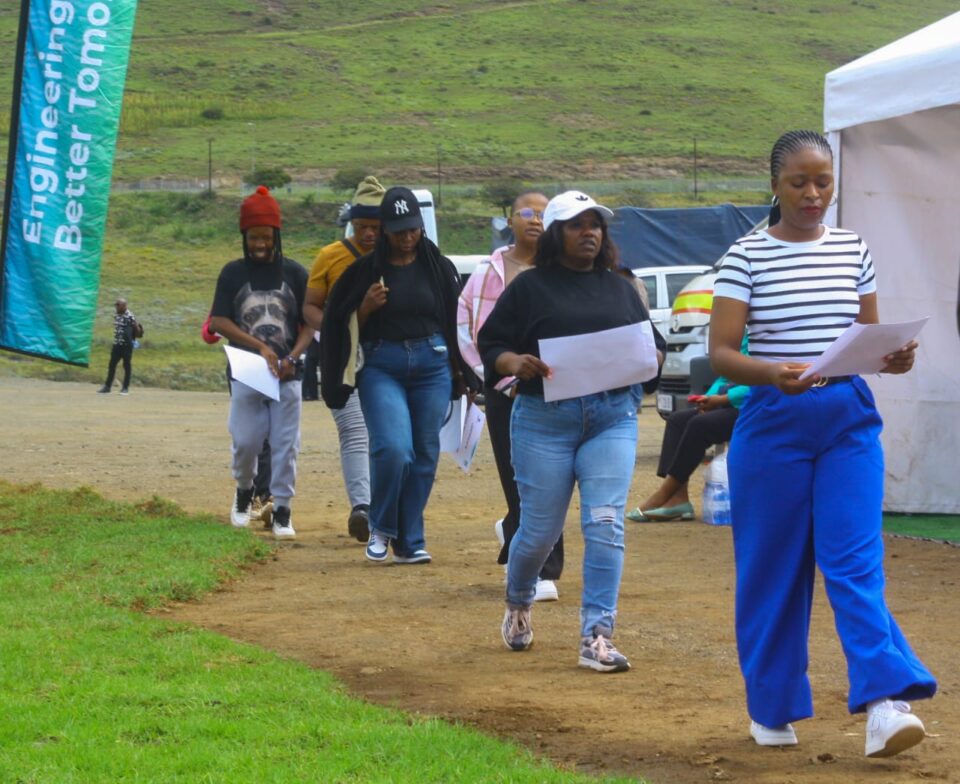
…amid LHDA skills accreditation programme
Kabelo Masoabi
A total of 386 young men and women—mainly from Lesotho’s mountainous districts of Thaba-Tseka, Mokhotlong and Leribe—are set to enter the workforce after completing a skills testing and accreditation programme aimed at boosting employability and promoting entrepreneurship.
The initiative, launched in 2025 by the Technical and Vocational Education Department (TVED) under the Ministry of Education and Training in partnership with the Lesotho Highlands Development Authority (LHDA), is designed to equip participants with practical, industry-relevant skills. It specifically targets rural communities, where access to formal employment opportunities remains limited.
Of the 646 individuals who initially enrolled, 386 met the accreditation requirements and were awarded certificates at a ceremony held in Katse on Thursday. The training focused on construction-related trades, reflecting growing demand for skilled labour in infrastructure development.
In plastering, 101 participants were certified, with Leabua Sello and Lefaso Adam among the top performers. Roofing produced 48 graduates, led by Selemela Molise and Fusi Mosuping. A total of 116 participants qualified as bricklayers, with Liphapang Teteisi among the leading achievers. Stone building—an essential skill given Lesotho’s terrain—saw 78 graduates, including standout performers Ntsane Sello and Motingoe Sejanamane. Meanwhile, 43 participants completed welding training, with Paseka Nkopane and Nkoakoa Khalala ranked among the best.
LHDA Acting Polihali Operations Branch Manager, Limpho Moeko, said the programme is a flagship initiative under Phase II of the Lesotho Highlands Water Project, aimed at accelerating access to employment for people living within the project area by formally recognising their skills.
“The programme identifies community members who already possess practical abilities in construction-related trades but lack formal certification. Without recognised credentials, many were previously unable to access employment opportunities within the project,” Mr Moeko said.
One of the graduates, Kape Tota from Ha Mikia, who specialised in stone building, highlighted the importance of certification.
“Many Basotho have strong vocational skills but lack formal recognition. This has often resulted in job opportunities going to foreign workers instead of local people. That is unfair,” he said.
He said the initiative has so far benefited more than 1000 people in Mokhotlong alone, many of whom are now accessing employment opportunities under Phase II of the project. The certification is recognised across the Southern African Development Community (SADC), broadening employment prospects for graduates.
The programme highlights the growing importance of Technical and Vocational Education and Training (TVET) in Lesotho’s economic development strategy. With youth unemployment at critically high levels—widely regarded as a national crisis—TVET is increasingly seen as a practical solution to improve job readiness and reduce reliance on the public sector.
Research shows that individuals who undergo vocational training are more likely to secure employment, with participation improving job prospects by more than 12 percent compared to those without such training. TVET is also gaining recognition as a pathway to entrepreneurship, equipping young people with skills to start small businesses and generate income in underserved communities.
The government has taken steps to modernise the sector through reforms outlined in the Lesotho TVET Policy (2019), which emphasises competency-based training aligned with evolving labour market demands. These efforts are supported by the Education Sector Plan (2016–2026), which prioritises improved access to and quality of vocational education nationwide.
Despite this progress, challenges remain. Thaba-Tseka Technical School director, Khotsofalang Rabale, said social stigma continues to hinder uptake of vocational education. Often viewed as a secondary option to academic pathways, TVET still struggles for recognition as a viable career choice.
However, stakeholders remain optimistic that continued investment, awareness campaigns and success stories from such initiatives will gradually shift public perception and encourage more young Basotho to pursue skills-based training.
“As these newly accredited graduates prepare to enter the job market or establish their own enterprises, their achievements mark an important step towards building a more skilled, self-reliant and economically resilient Lesotho,” said parliamentarian Advocate Lekhetho Rakuoane.
Meanwhile, a community-based tourism training initiative—implemented in partnership with the Lesotho Tourism Development Corporation—is helping local communities benefit directly from tourism opportunities linked to the project.
“This initiative aims to co-create sustainable tourism products that will generate long-term benefits for local communities,” Mr Moeko added.
’Malehloa Tseko from Rapoea, who qualified as a tour guide, said the training has equipped participants with essential skills. She noted that the annual Katse Dam Tourism Festival provides an ideal platform to attract visitors interested in hiking and exploring local attractions, whether on foot or horseback.
5 comments
steroid reddit
References:
https://rentry.co/no5r94ty
prednisone substitutes
References:
sportpoisktv.ru
what are the disadvantages and side effects of cortisone injections?
References:
https://pads.jeito.nl/s/5QqQzVIOPk
legal steroids celebrities use
References:
squareblogs.net
best supplement stack for cutting and muscle gain
References:
md.chaosdorf.de
Comments are closed.