

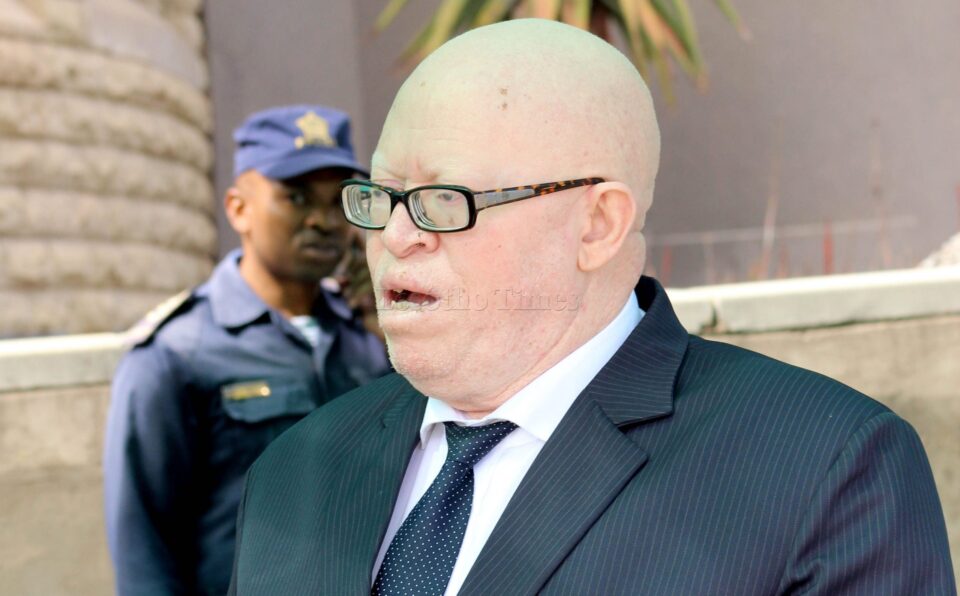
—says his alleged transgressions have not been detailed
Mohloai Mpesi
National University of Lesotho (NUL) Pro-Vice-Chancellor, Professor Kananelo Mosito, has questioned his suspension from the country’s premier institute of higher learning, saying the transgressions he is accused of committing have not been properly amplified.
Prof Mosito, who is also the President of the Court of Appeal, says as the NUL Council had not specified how he committed any of the alleged transgressions, he was not in a position to respond in any detail.
“The lack of detail makes it difficult for me to respond….,” Prof Mosito told the Sunday Express yesterday.
He was slapped with the suspension letter on Friday for “rendering the university ungovernable”.
Professor Mosito said it would have been helpful if the details of how he had made the university ungovernable had been properly explained to enable him to respond adequately. That was what rules of fairness and natural justice demanded.
According to an NUL circular summarising decisions from the 5th Special Meeting of the 15th Council held on 22 April 2026, Council adopted a recommendation by its chairperson, Dr Khabele Matlosa, to suspend Prof Mosito.
“Council considered and adopted the recommendation of the Chairman of Council to place Prof Kananelo Mosito on suspension and exclusion from work as Pro-Vice-Chancellor, pending investigations.
“The suspension is due to allegations that, as a member of the university executive management and an ex-officio Council member, he is bent on rendering the university ungovernable in pursuit of personal interests which conflict with the best interests of the university that he should be protecting,” the circular reads.
The circular further states that Council had reversed the approval of Vice-Chancellor Professor Olusola Isaac Fajana’s annual and terminal leave of 51 days because of the “exigencies of work”. The decision effectively recalls Prof Fajana from his leave and closes the door for Prof Mosito to be appointed acting vice-chancellor for that leave period.
“Council further approved that the Vice-Chancellor be compensated financially for the leave days earned,” the circular adds.
Prof Mosito had been expected to act as Vice-Chancellor during Prof Fajana’s leave because he is effectively the number two in the university’s administrative hierarchy.
Speaking to the Sunday Express yesterday, Prof Mosito said he had received multiple letters regarding the suspension, some of which were later withdrawn, leaving him uncertain about his status.
“I received letters that were written and withdrawn many times. I realised that the Vice-Chancellor wants to sabotage me. Sometimes issues are released by him, at other times by other people,” he said.
He added that the matter of his suspension had not been part of the agenda for the Council meeting held on Wednesday.
“I saw on social media that Council had resolved to suspend me. The Council papers for that meeting did not include that issue. When the Council sits, it considers prepared (agenda) papers with specific recommendations. It can either adopt or reject them,” he said.
Prof Mosito said he was now awaiting a clear and formal explanation of the allegations against him.
“If they say I am rendering the university ungovernable, they must explain how. I cannot respond to unclear issues,” he said.
But he hinted that his suspension could be linked to a legal challenge he filed against the Council over its decision to begin recruiting a new Vice-Chancellor before the incumbent’s contract expires.
“They cannot hire someone when the substantive (official) is still in office. I learned that they got angry when I tried to correct them for infringing the law.”
Prof Mosito recently approached the High Court seeking to block the recruitment process, arguing that Prof Fajana’s term only ends in July 2026. Prof Mosito maintains that the recruitment process is unlawful because it was initiated before a vacancy officially arose, in breach of Section 16(2) and (6) of the National University of Lesotho Order, 1992.
He contends that recruitment can only begin once a vacancy exists, which would be in August.
However, Dr Matlosa has in his opposing papers, has dismissed the application as meritless and self-serving, questioning Prof Mosito’s legal standing and motives. He argues that the recruitment process is intended to avoid an administrative vacuum once the current Vice-Chancellor’s term ends.
Dr Matlosa further alleges that Prof Mosito’s court action amounts to an abuse of process, suggesting it is aimed at positioning himself for the role of Acting Vice-Chancellor and ultimately the substantive post. He takes umbrage with the fact that Prof Mosito heads the Court of Appeal and was seeking a remedy in courts controlled by his juniors.
The matter is expected to proceed before the High Court tomorrow.