

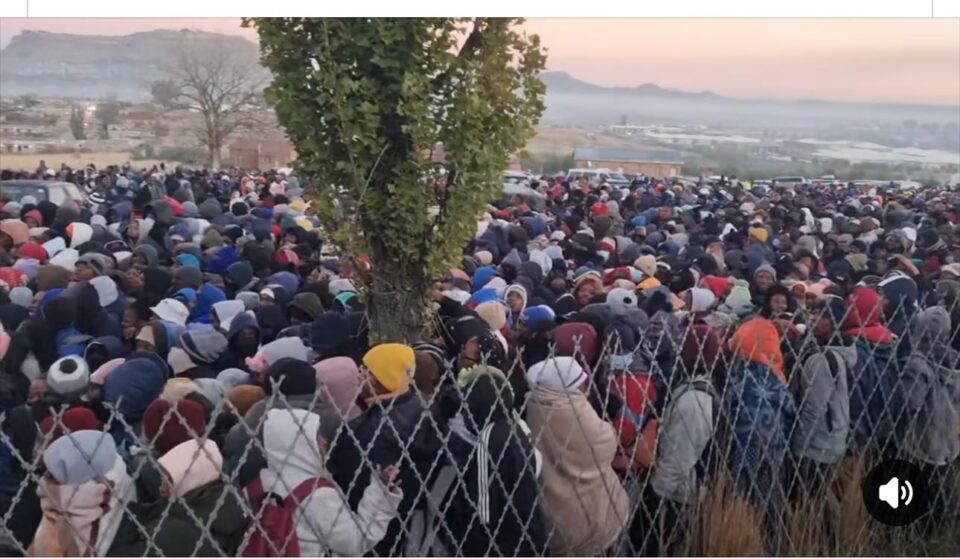
…as thousands gather at LDF for only 500 soldier vacancies
Moroke Sekoboto
THE nation’s soaring unemployment rate has been described as a ticking time bomb – one that threatens to explode into a national crisis if left unaddressed.
It is no longer just a statistic, but a security threat, a social emergency, and a crime in itself.
This grim reality was laid bare yesterday when thousands of young Basotho, aged between 18 and 28, descended on Makoanyane Barracks in Maseru, hoping to secure one of the 500 vacancies in the Lesotho Defence Force (LDF).
The sea of hopefuls came from across Maseru, while others were also queuing in their respective districts.
In April, a coalition of youth organisations and political parties urged the government to declare youth unemployment a national emergency.
They warned that over 38 percent of young people were jobless, trapped in a cycle of poverty and hopelessness while political elites continue to benefit from state privileges.
The youth organisations behind the call included Bacha Shutdown, On-Point Foundation, Youth AIDS Free Foundation, Youth in Action, Social Reformers Initiative, People’s Matrix, Lesotho Network Development of the Blind, Lesotho Youth Summit, and Voice of Youth Society.
Political party youth leagues involved were from the Democratic Congress (DC), All Basotho Convention (ABC), Basotho National Party (BNP), Socialist Revolutionaries (SR), Basotho Action Party (BAP), and United African Transformation (UAT).
And now Section 2 President, Kananelo Boloetse, pulled no punches in his assessment of the crisis. Speaking to Sunday Express yesterday, he said the youth unemployment rate reflects years of failed leadership and has become a dangerous powder keg.
“What we saw today is alarming. It is the direct result of leadership failure. Our leaders have not created employment opportunities for the youth,” Mr Boloetse said.
“Unemployment is a ticking time bomb, a security threat, and a crime waiting to happen, if it has not already.”
He criticised the LDF recruitment process as “demeaning and embarrassing”, adding that the current model unfairly favours youth living near Maseru while disadvantaging those from remote areas like Semonkong.
“Calling everyone in Maseru to submit applications in person is unfair. What about those from far-flung areas who cannot afford accommodation? Applications should be done online and shortlisted candidates should be called for interviews.”
Mr Boloetse urged the government to declare youth unemployment a national crisis.
“It is not just our opinion, evidence is everywhere. Our economy is in foreign hands. The government must take back control, support local businesses, and expand trade within Africa.”
Also speaking to this publication yesterday, Lesotho Youth Summit’s member, Tšepo Nkhabu, echoed these concerns. He said the sheer number of applicants showed how dire the situation has become.
“Some of these young people slept at Makoanyane just to be among the first in line. That is how desperate they are. The number of applicants even overwhelmed the interviewers,” Mr Nkhabu said.
He called for innovative solutions and even proposed an “ideas national referendum” to tackle unemployment head-on.
“We have over 250,000 unemployed people in Lesotho. This issue isn’t new but just getting worse. A referendum would allow everyone to contribute ideas and find a collective solution.”
The Democratic Congress Youth League (DCYL) said the situation had gone beyond a search for employment, but now a cry for survival. They lamented how army recruitment, once driven by patriotism and duty, has become a last resort for the hungry and desperate.
“The youth are not chasing a calling to be soldiers, but are rather running from hunger. The uniform, once a symbol of honour and sacrifice, is now seen as a lifeline,” DCYL said in a statement yesterday.
They warned that if young people continue to find no hope in education, agriculture, entrepreneurship, or innovation, they will end up “crowding prisons or fleeing across borders”.