

Tšeliso Tšenoli
IF I were an aspiring entrant into Lesotho’s dairy industry by way of direct investment — be it foreign or domestic — my first port of call for strategic analysis would be the Lesotho National Dairy Board (LNDB).
This is because the LNDB has a statutory mandate to be both the mentor and steward of Lesotho’s dairy industry through its marketing institutional framework.
It is also because it is a statutory window on the investment climate for commercialisation of the dairy industry.
The following functions are within the ambit of the LNDB, as purported by the Lesotho — Canada Dairy Development Project — Phase II.
- Supporting and encouraging the development of dairy associations and milk collection centres in the county; and
- Strengthening of services and skills in the dairy extension sector.
The powers of the LNDB, according to regulations under Act#246 of 1991, shall be:
— To prescribe standards of production of dairy products;
— To grant or withdraw permits for production, processing, and distribution of dairy products through regulations issued by the Minister.
— To determine prices for the dairy products.
— To impose levies and charges on the production, processing and distribution of dairy products as may be authorised through regulations by the Minister;
— To ensure that products offered to the consumer are of a standard suitable for public health; and
— To prescribe types, grades and quantities of products imported, exported, produced and sold in Lesotho.
The overarching function of LNDB is to promote and enhance the development of Lesotho’s dairy industry.
By his own admission, the LNDB executive says he has not been told to handle marketing problems in the dairy industry director, 23 years down the line.
The same executive director disclosed to the Lesotho Times, only last year, that the LNDB has spent M1.5 million to re-furbish the processing plant.
But as we speak now, there is no operational processing plant at Lepereng — the little milk being produced is being sent to South Africa.
The reason the milk quantities are small is dairy farmers have fallen by the way side under the M3.68 per litre producer-price yoke, paid by the Lesotho Dairy Products (LDP) to the hapless dairy farmers.
The M1.5 million question therefore becomes: How was the money spent since there was no refurbishment of the operational plant?
Were the normal supply chain prescripts followed in the so-called refurbishment? Who were the three contenders for the refurbishment contract?
How and by whom were they evaluated or assessed? Who made the selection?
We are hoping that the questions will be easy to answer, if only with sincerity. However, the most important question is whose processing plant is that one for refurbishment in the amount of M10 Million or M12 Million?
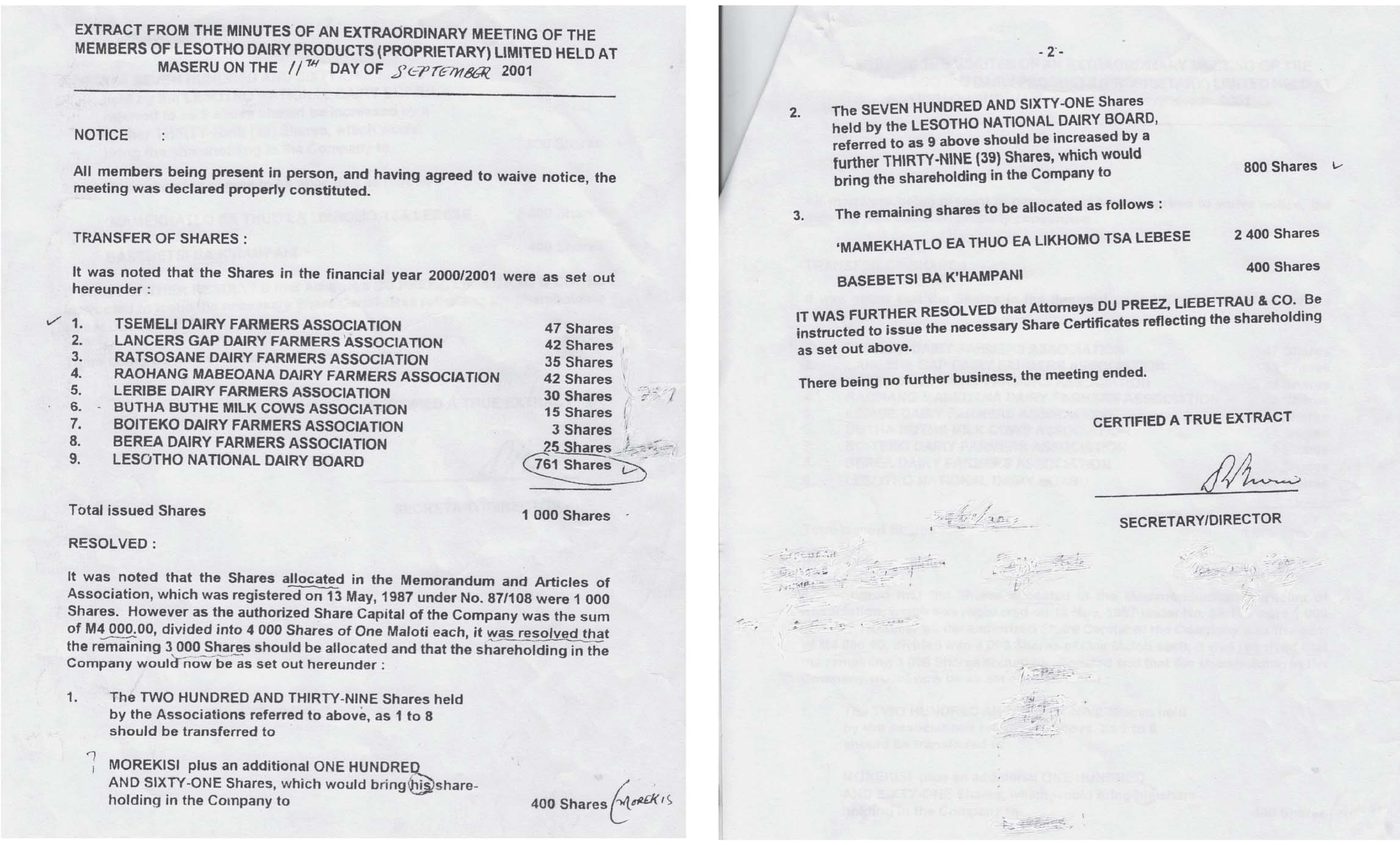
Can this last question be answered in light of the extract from the minutes of an extra-ordinary meeting of the members of LDP held in Maseru on September 11 2001.
Are we aware that it was resolved to expropriate shares from the listed Dairy Farmers Associations to:
— Among others — Denmar (Morekisi) who is supposed to have been engaged to deliver milk from the plant to local outlets?
In whose possession were the share certificates, more so because the associations never admitted to having them?
There are too many questions that were asked around this issue, and that were never answered to-date.
Dairy farmers want the ownership and administration of the processing plant issue resolved before taxpayers funds can be transferred to LNDB for the plant refurbishment.
LNDB collects levy on all imports of dairy products at the rate of 2.25 percent. Where and how is this money spent for the benefit of small holder dairy farmers?
Todd Thompson, under the auspices of the Commonwealth Fund for Commodities conducted a strategic analysis of Lesotho’s dairy industry; and chief among questions that he posed was, where does the levy go?
He conclusively articulated his inference that: it would be a waste of time and money to invest in Lesotho’s dairy industry, for as long as LNDB and LDP exist.
This assessment was done some years ago. Please refer to the pasted diagram of the marketing institutional framework for digestion.
Lesotho’s dairy farmers also blew the whistle on gross mismanagement of the industry — through a petition to the Ministry of Agriculture — way back in 2006, under the Matsibolo Dairy Farmers Association banner.
We take solace in Lesotho’s express preparedness and resolve to intervene and redress the abyss of our marketing institutional framework for the betterment of the much-needed conducive investment climate and employment generation for the rural and urban masses of our people.
We have already learned, through empirical evidence that, while we yearn for commercialisation, government must look upon a producer as a simultaneous consumer of its own produce.
When a dairy farmer wants to buy fresh milk from the LDP plant, they pay M7.50 per litre, after delivering the same litre for around M3.68.
The buyer refuses to account for the M3.82 difference on a litre. We do not deny that there may be the difference; but not that much, which is debilitating to a producer.
When the hapless farmer needs half a litre of bottled water he pays M6.50, when he has just received M3.68 for a whole litre of milk.
If the same farmer sold his produce direct to a consumer at farm gate, the buyer would take kindly to the M7.50 per litre price as a fair price.
Because of the perishable nature of milk, the home market becomes the only alternative outlet for the producer; however, the LDP buyer actively discourages consumers from buying direct from the farmer, without offering any alternative for the hapless farmer.
Today the Lesotho dairy farmer needs a processing facility amenable to his needs, not the high-jacked CIDA — donated plant at Lepereng. This is where government must come in.
The original Lesotho — Canada Dairy Development Project: Phase II will inform such remedial action.
Fortunately Ma-aparakobo Dairy Farmers Association have a recommended roadmap.
Zambia is today self-sufficient in milk production, according to information obtained from Veterinary Governance Programme Director (Inter African Bureau For Animal Resources: African Union).
For as long as LNDB exists, there cannot be any development of the dairy industry — we must change the law. This is where government must come in.
In order to register any sustainable dairy industry development, we must capacitate the dairy farmer to become a “master of his own destiny”.
Any reader who is interested, must contact the LNDB’s chairman who must have the information in respect of present members of the board, their representativity and proof of appointment.
Domestic direct investment is an attestation to desirable viability of any industry. The rate at which dairy farmers are quitting should be cause for concern.
Unfortunately, domestic direct investment plays onto ‘MIP’ — Minimum Infrastructure Platform) to motivate Foreign Direct Investment.
It looks like we have to put our own house in order first, before touting foreign direct investors.
Having said that, a more balanced sectoral distribution of LNDB’s equity portfolio, in favour of agricultural industry is in order.
The theme of our current national budget is: “Beyond stability: Towards Economic Transformation that works.” The livestock sector’s contribution to GDP is 4.5 percent, against 2.7 percent for crops.
To us, this means our national budget must resonate demonstrable recognisance of the dire need for pro-actively balanced, visionary, strategic, and corruption – free resource allocation.
Mary Louise Penrith, in her overview of ‘‘The livestock sector in the Sadc region’’ July 2013, made the following observation:
“Although relatively low livestock numbers have been cited as one reason for poor performance of the sub-Saharan African Livestock sector, there is strong evidence that the problem is low production rather than availability of livestock.
For example, Europe, with only 8.4 percent of the world’s cattle, produced 16.8 percent of the world’s beef in 2011, while Africa produced only 9.9 percent of the world’s beef from 20 percent of the cattle.
There are many factors that contribute to the low productivity, but the single over-riding challenge is that Africa and the Southern African Development Community, need to manage their livestock resources better and more sustainably to reverse the decline that has been noted in much of the sector”.
Better-managed livestock resources, through better-managed marketing institutions whose sustainability can be better guaranteed through ownership by “masters of their own destiny” — the farmers and producers, provide us with the road-map to desirable agricultural productivity.
When CIDA (Canadian International Development Agency) donated the Milk Processing Plant in 1987, it was with this in mind.
Attestation to our inference is in the Project Description — Lesotho Canada Dairy Development Project Phase II. In conclusion, we are gratified to note that Lesotho is hosting Southern African Confederation of Agricultural Unions meeting tomorrow.