

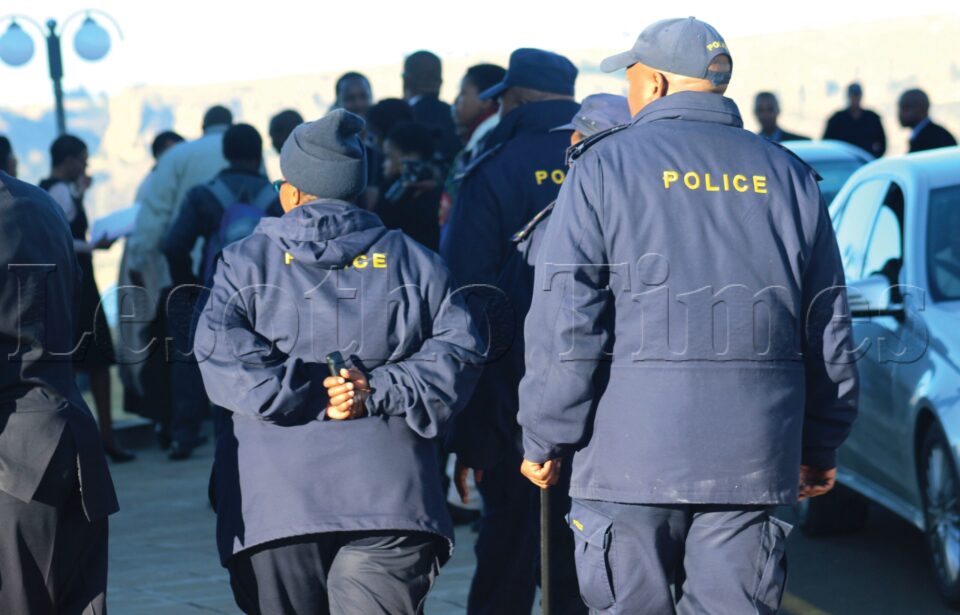
THE long-running dispute over the proposed M1500 monthly risk allowance for members of the Lesotho Mounted Police Service (LMPS) has once again brought into focus the difficult and often thankless job performed by police officers.
While the proposed allowance has been caught up in bureaucratic delays, disagreements and union pressure, the underlying question deserves serious consideration: how does the country recognise and compensate those entrusted with protecting its citizens?
Police officers deserve to have their occupational risks recognised. Their work is inherently dangerous, unpredictable and, at times, thankless. Unlike many public servants who operate within relatively predictable working environments, police officers routinely confront situations in which their lives are at risk.
They deal with armed criminals, violent suspects, dangerous traffic situations and volatile public gatherings. They are expected to respond to emergencies regardless of the time of day, weather conditions or personal circumstances.
It is therefore difficult to understand why an agreement to improve their risk allowance should become such a protracted administrative exercise.
The proposed increase from M100 to M1500 is not an extravagant demand when considered against the responsibilities officers carry. Indeed, the existing M100 allowance, which has been in place since 1994, has long raised questions about whether the government genuinely appreciates the risks associated with policing.
The public, too, has a responsibility to acknowledge the work of the police. While criticism of the LMPS is sometimes justified, particularly where officers are accused of corruption, brutality, incompetence or failure to investigate crimes, it would be unfair to paint the entire service with the same brush.
There are officers who work tirelessly, often under difficult conditions, to keep communities safe. Some put their lives on the line in circumstances most people would rather avoid. They deserve recognition for their commitment.
There is also a noticeable change in the public’s experience of certain types of crime. It is increasingly difficult to recall when last reports of vehicle hijackings dominated public conversation in the way they once did. Even road accidents associated with drunk driving appear to have declined in recent times.
While these observations should not be mistaken for comprehensive crime statistics, they point to a public perception that deserves investigation. If the incidence of particular crimes has declined, the police deserve to be among those whose efforts are examined when explaining that development.
Of course, crime has not disappeared from Lesotho. Criminal activities continue to threaten communities, and citizens still have legitimate concerns about the effectiveness of policing. There are also serious questions about the LMPS’s capacity to deal with organised crime, illegal firearms, stock theft, drug trafficking and other security challenges.
But acknowledging these shortcomings should not prevent the country from recognising the risks officers face in carrying out their duties.
The government must also appreciate that a demotivated police service is not in the public interest. Officers who feel undervalued may become increasingly disillusioned, and that can have consequences for morale, discipline and service delivery. This is particularly concerning in a country where public confidence in law enforcement remains essential to maintaining peace and stability.
This brings us to the latest developments involving Home Affairs and Police Minister, Voesewa Tsheka, and the Lesotho Police Staff Association (LEPOSA).
After months of disagreements, the minister reportedly announced at the association’s annual general meeting last weekend that the parties had reached an agreement and that the allowances would begin reflecting in officers’ November salaries.
This is welcome news, although it is unfortunate that it took an ultimatum and the threat of further industrial action to bring the parties back to the negotiating table.
LEPOSA has understandably adopted a cautious position. Deputy president, Senior Inspector Haleeo Leluma, has made it clear that the association wants a written collective bargaining agreement signed by the relevant stakeholders before accepting the latest undertaking.
That caution is understandable. The association says an earlier agreement reached on 29 June 2026 provided for the allowance to be introduced in three phases, with M500 payable from October 2026, another M500 from April 2027 and the final M500 from April 2028. However, the minister subsequently indicated that implementation could not proceed without further administrative and financial considerations.
The latest announcement must therefore translate into something tangible. Verbal assurances are not enough, particularly after months of uncertainty and a previous change of position.
Ms Tsheka must ensure that the outstanding processes involving the Ministries of Finance and Public Service are concluded without further unnecessary delays. If there are genuine financial or administrative obstacles, these should be communicated openly rather than leaving officers guessing about their welfare.
At the same time, LEPOSA must recognise that securing better conditions for its members comes with responsibilities. The association should continue engaging constructively with the government while ensuring that its members remain disciplined and committed to their constitutional duties.
An improved allowance must go hand in hand with improved accountability. The public expects police officers to uphold the law, respect human rights, investigate crimes professionally and treat all citizens equally. Better remuneration cannot become an excuse for misconduct or a shield against scrutiny.
Similarly, the government must not regard police welfare as an inconvenience to be addressed only when workers threaten industrial action. A properly motivated, adequately equipped and professionally managed police service is an essential investment in national security.
Ultimately, the M1500 allowance debate should be about more than a monthly figure on a payslip. It should be an opportunity to reconsider how Lesotho values the men and women who protect its people.
Those who risk their lives to keep the rest of us safe should not have to spend months fighting their own government to secure recognition of those risks. But recognition must also be matched by professionalism, accountability and measurable improvements in policing.
Sakoane’s push to grow the Bench deserves support