

…as project costs soar to M461m
By Mohloai Mpesi
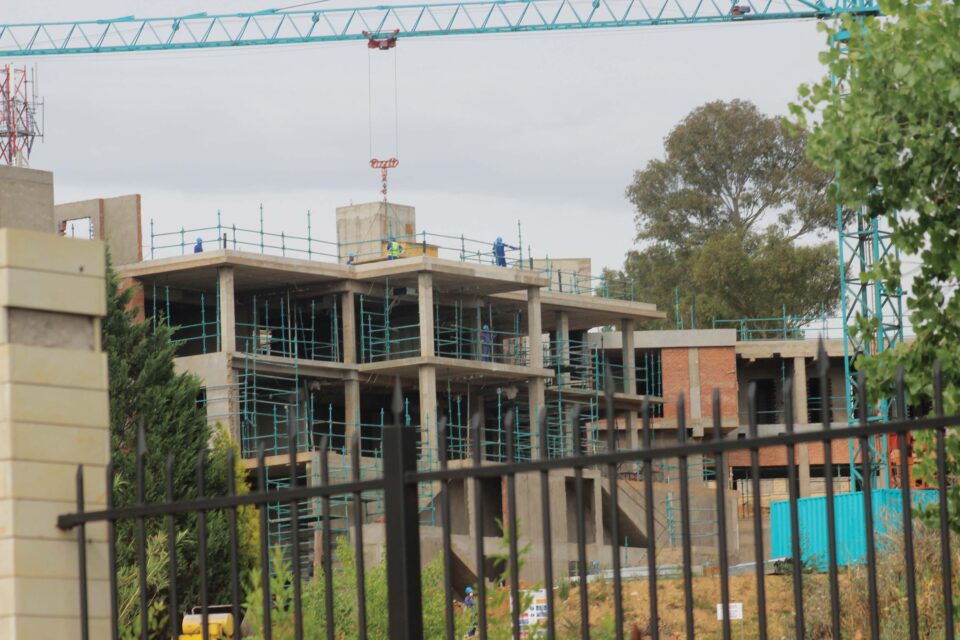
THE government has set aside M50 million to resume construction of the new Royal Palace in Maseru, a project that has dragged on for more than a decade and already cost taxpayers hundreds of millions of maloti.
This according to a report by the Senate’s Committee on Government Assurances (CGA), compiled after scrutinising the Auditor-General’s May 2025 audit report on the construction of the new palace, which is intended to serve as the official residence of Their Majesties King Letsie III and Queen ’Masenate Mohato Seeiso.
The audit, conducted by Auditor-General ’Mathabo Makenete, exposed a litany of administrative, financial and procedural failures. It found that the project’s cost had ballooned from an initial M136.7 million to M355 million by the time the audit was conducted in 2025.
It also uncovered overpayments amounting to more than M74 million to consultants and the contractor. A follow-up audit was subsequently initiated after a former principal agent made fresh disclosures to the Auditor-General’s office.
The CGA report, released by the Senate on Thursday, states that the government has earmarked M50 million for the resumption of the project, whose construction started in 2011 but remains incomplete.
“The ministry (Public Works and Transport) further informed the Committee that Cabinet has already earmarked money amounting to M50 million for the resumption of the project. In addition, the ministry was advised to work closely with the Lesotho Public Procurement Authority (LPPA) to strengthen compliance with procurement laws and procedures,” the report reads.
The report further states that the Ministry of Public Works and Transport has developed a procurement strategy intended to prevent a recurrence of the irregularities that have dogged the project since its inception.
“On the same note, the ministry has already developed a procurement strategy to guide the procurement process and ensure full adherence to the applicable procurement rules and regulations during the implementation of the project.
“The ministry stated that preparations are under way to resume the construction project soon and it assured the Committee that corrective measures have been put in place to prevent the recurrence of the shortcomings identified during the previous implementation phase,” the report reads.
Background
Construction of the palace in Maseru has been plagued by design disputes, contract terminations and escalating costs since its inception.
In November 2008, the government engaged South African firm Palace Architects to design the new Royal Palace. In August 2011, LSP Construction was awarded the construction tender. Lethola Cost Associates was appointed project quantity surveyor, Aurecon Lesotho civil and structural design engineer, and Dylec Consulting mechanical and electrical engineer. The project was initially valued at M136.7 million.
Construction was expected to take 18 months, with completion scheduled for May 2013. However, the project quickly ran into difficulties.
In April 2013, the ministry’s Buildings Design Services (BDS) suspended construction after terminating Palace Architects’ contract.
The project remained on hold until Makeka Design Lab (MDL) was appointed in October 2014 to replace Palace Architects. Construction only resumed on 19 October 2016, after MDL revised the original design, enlarging the structure and introducing additional features. By then, the project cost had risen to approximately M358 million.
In July 2018, BDS terminated MDL’s contract and appointed its in-house architect, Peter Ramalitse, who again amended the design to incorporate further features.
Two months later, in September 2018, BDS appointed Nyolohelo Mohale as principal agent (clerk of works), further altering the contractor’s mandate.
Construction could not resume even after a new memorandum of agreement was signed with LSP in May 2021. By that time, the project cost had escalated to approximately M411 million.
The additional M50 million now earmarked for the project brings its projected cost to M461 million, just M39 million short of half a billion maloti.
Engagement of Their Majesties
The report further reveals that the ministry has approached the Royal Family to discuss the continuation of the project and establish their expectations for the building.
“The ministry informed the Committee that it had already written to the Senior Private Secretaries (SPS) to the Majesties requesting an audience with Their Majesties.
“The purpose of the proposed meeting is to engage the Royal Family and obtain clarification of the type and specifications of the Royal Palace they wish to have constructed. This is intended to ensure that the project proceeds in accordance with Their Majesties’ expectations and requirements,” the report reads.
‘We have failed the project’: Lemphane-Letsie
Member of Parliament and Hope-Mphatlalatsane leader, ’Machabana Lemphane-Letsie, says successive governments have failed to complete the Royal Palace, describing the project as a national embarrassment.
She has proposed handing it over to the United Nations Development Programme (UNDP), citing the organisation’s expertise and potential to mobilise co-financing.
Ms Lemphane-Letsie was speaking in the National Assembly this past week during debate on a report by the House delegation that undertook a study tour to Sierra Leone on Government Development Financing (GDF).
The delegation visited Freetown from 2 to 6 August 2026 to study how the country works with UNDP to finance development projects without placing additional pressure on the national budget. The report was tabled in the House on Monday, 12 October 2026.
“We went to many places in Sierra Leone, but the intention was to observe how we can best work with UNDP without compromising our budget, how we can help ourselves to secure funds for our projects, and how Parliament would monitor the utilisation of the money,” she said.
She said it was embarrassing that successive administrations had failed to complete the Royal Palace and suggested that the government consider handing the project to UNDP to ensure its completion.
“We have projects that have defeated us. They embarrass us as a country. One wonders how much money we have lost through unfinished projects.
“Maybe now that we are heading towards the end of the term, the government should advise itself to approach the UNDP with this matter.
“There is a project that embarrasses us a lot. The Royal Palace. We have to admit that we have lost,” she said.
She added: “I think the strategy that I saw in Sierra Leone can best help us remove the embarrassment and save us money, because some of us were part of government when the building started, and now we are Members of Parliament, and it is clear that there is a lot of conflict in the government. Those in charge of the government come from the business industry, while some of those in the government were part of the work on that house.
“I think we should give the project to UNDP through its expertise and co-financing. I think it will remove the embarrassment. I am so embarrassed by the Royal Palace.
“This is one of those projects on which we can try other strategies, including the one that we saw in Sierra Leone. There are many other projects that the government found as they are, and it will leave them as they are. Maybe we need another strategy other than the ones that we are using right now.”
Recommendations
The CGA has called on the Ministry of Public Works and Transport to strengthen project management and oversight to prevent further financial losses.
“The Committee recommends that the ministry strengthen their project management and oversight throughout the implementation of all projects.
“The ministry should take full responsibility for the consultants and contractors they engage, ensuring that they are properly supervised and held accountable for the execution of their contractual obligations,” the report reads.
The Committee also directed the ministry to submit all records relating to the engagement of Mr Mohale as Clerk of Works/Principal Agent (CoW/PA).
According to the report, the ministry acknowledged that it had no official documentation confirming or authorising Mr Mohale’s appointment to the position.
“The ministry further acknowledged that, based on the records available to it, the purported CoW/PA was not properly engaged through a documented appointment or contractual arrangement authorised by the ministry,” the report reads.
The Committee wants the ministry to establish which officials initiated, approved and processed payments to Mr Mohale and provide the relevant documentary trail.
It also wants clarification on Mr Mohale’s relationship with Dylec Consulting Engineers, particularly the May 2019 arrangement concerning CoW/PA services, and how this related to his earlier involvement in the project.
Recovery of wrongly paid funds
The report further recommends that the ministry recover money irregularly paid to various companies and individuals during the project’s previous implementation phases.
It also finds no documentary evidence linking former Public Works Principal Secretary (PS) Mothabathe Hlalele to Mr Mohale’s appointment.
“The available chronology establishes that Mr Hlalele was the Principal Secretary for the Public Works function in September 2018, when Mr Mohale was reportedly engaged as CoW/PA. However, the ministry submitted that there is no documentary evidence establishing that Mr Hlalele authorised, approved or participated during the engagement under scrutiny.
“It is recommended that the said CoW/PA be required to refund the M5,491,426.46 that was wrongly paid to him, as there is no valid or clear contractual agreement establishing how he was engaged as CoW/PA.
“In the absence of a clearly defined contractual relationship, the payment cannot be justified and should therefore be recovered.
“The ministry recommended that the consultants who received overpayments should not be re-engaged for the resumed project. The ministry explained that this approach is intended to encourage the consultants to refund the amounts that were overpaid,” the report reads.
According to Ms Makenete’s audit, M32,302,028.37 was overpaid to five consultants, while M42,197,693.14 was overpaid to the contractor.
Palace Architects received M3,641,492.66 in retrospective payments for completed design stages.
MDL was overpaid M2,883,685.58, comprising M1,293,906.88 arising from an overestimation of professional fees for construction supervision and M1,589,778.70 for charging for full services instead of partial services, contrary to its contract.
Lethola Cost Associates also received several irregular payments. The firm was paid M78,643.65 for failing to follow procurement regulations on lump-sum fixed contracts.
It was further overpaid M2,546,035.93 through the use of an incorrect band of the Tariff of Professional Fees (TOPF-SACQSP) in calculating its fees, M13,576,361.91 through the misapplication of the tariff's variation clause, and M625,122.92 through the incorrect application of a clause relating to multiple procurement contracts.
The report also found that Aurecon and Dylec Consulting Engineers received a combined M1,633,823.99 without a contractual basis.
Aurecon received M1,053,772.06 arising from irregular calculations of professional fees, while Dylec was paid M580,051.93 for redesign work that was not provided for in its contract. The payments were based on methodologies outside the signed agreements and inconsistent with professional guidelines, rendering them unsupported, according to the audit.
The Auditor-General further found that M3,729,606.38 was paid to two consultants and the contractor without documented evidence of work progress.
Dylec received M1,210,508.45 despite there being no cumulative progress in works supervision, while Aurecon was paid M186,684.30 without any reported progress during the construction phase.
LSP Construction was also paid M2,332,413.63 for work allegedly completed while the project was suspended.