

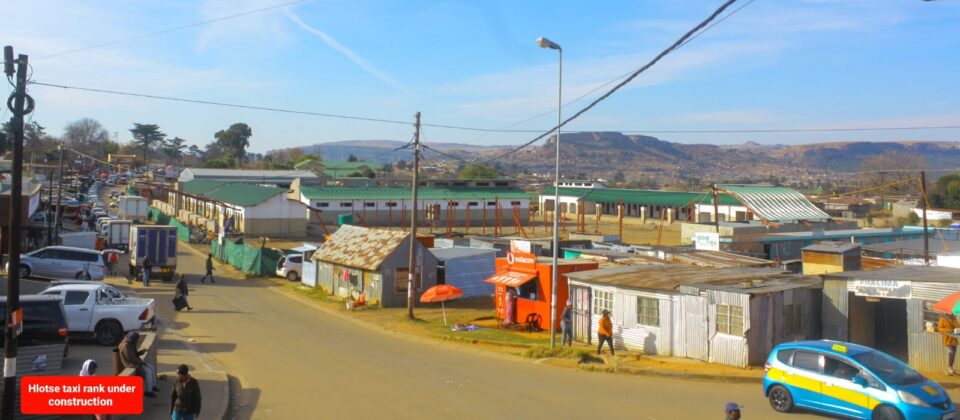
…as delayed Hlotse taxi rank project leaves vendors and operators struggling
Kabelo Masoabi
VENDORS and taxi operators in Hlotse, one of the stwo Leribe’s principal commercial centres, initially welcomed the construction of a modern taxi rank with optimism, believing it would transform the town’s transport system, improve trading conditions and boost their livelihoods.
The proposed facility promised proper trading spaces, sanitation, electricity and improved commuter services, raising hopes of a more organised and economically vibrant transport hub.
More than a year later, however, that optimism has given way to frustration, uncertainty and financial hardship.
The prolonged delay in completing the project has left hundreds of street vendors, transport operators and commuters struggling at a temporary site that lacks even the most basic public amenities.
The relocation of taxis and vendors from their former operating area was meant to pave the way for construction of the long-awaited taxi rank. Instead, it has disrupted businesses, reduced customer traffic and exposed traders and commuters to unsafe and undignified conditions.
Businesses fighting for survival
Many vendors who relied entirely on daily sales to support their families say they are now struggling to make ends meet.
Businesses that depend on electricity—including barber shops, hair salons, cell-phone charging and repair services, photocopying and printing businesses, carpentry workshops and welding operations—say they have been hit particularly hard after losing electricity connections during the relocation.
Without power, many operators have either shut down permanently or significantly scaled back their businesses, resulting in severe income losses.
Some traders say the harsh conditions have also taken a toll on their health. Constant exposure to extreme weather, coupled with poor sanitation, has made it increasingly difficult to continue operating.
Hlotse Street Vendors Association chairperson, Thabo Masoebe, said conditions at the temporary site had become unbearable.
“The unbearable conditions have forced some members to abandon the only source of income for their families because of deteriorating health,” he said.
Harsh weather and poor sanitation
The temporary taxi rank offers little protection from the elements.
During summer, commuters, taxi operators and vendors endure heavy rain, hailstorms and strong winds without adequate shelter. In winter, they are left exposed to freezing temperatures.
Sanitation has emerged as another major concern.
The temporary public toilets consist of makeshift pit latrines constructed from concrete sheets and situated near isolated bushes.
“The facilities have no security personnel, raising safety concerns, particularly for women and children. There is also no running water for washing hands or drinking, creating serious public health risks,” said Hlotse resident Makoa Thibeli.
Crime fuels insecurity
Beyond the deteriorating trading environment, security has become an increasing concern.
Veteran vendor, Alice Ntaope, said the temporary rank lacks proper lighting, surveillance systems and a visible police presence, leaving traders vulnerable to criminals.
Her concerns were reinforced by a recent burglary.
She said thieves broke into one trader’s shack last Sunday and stole stock and valuable business equipment.
More than 100 makeshift stalls at the temporary trading site remain vulnerable to recurring incidents of vandalism and break-ins because of inadequate security.
Mud, congestion and repeated relocations
Transport operators continue to grapple with operational challenges.
During the rainy season, the temporary rank becomes waterlogged, with vehicles frequently getting stuck while loading passengers.
Frustrated by the conditions, many taxi and bus operators abandoned the designated site and began operating along a narrow street adjacent to the Hlotse Central Court. Vendors followed in an effort to remain close to potential customers.
The arrangement, however, proved short-lived.
This past week, court authorities ordered the immediate removal of transport operators and vendors, complaining that noise from the busy loading zone was disrupting court proceedings.
Police supervised the relocation, forcing operators and traders to move elsewhere while earth-moving machinery continued preparing sections of the temporary site.
As a result, many vendors are now scattered across different parts of Hlotse in search of customers, further reducing their already fragile incomes.
Residents say the absence of a properly developed taxi rank has also created serious urban planning challenges.
With no formal loading facilities, taxis and minibuses travelling to villages across Leribe and other districts continue operating from various street corners throughout Hlotse, making it difficult for commuters—especially first-time visitors—to locate the correct transport.
The scattered operations have also contributed to congestion and disorder in the town centre.
“You can never be completely certain that the cab you are about to board is genuine or safe. There is always the fear that you could end up in the wrong vehicle and become a victim of crime, including kidnapping,” said commuter Nthabiseng Letsosa.
“These cabs wait for passengers along road pavements throughout the town, often operating without any visible inspection or oversight from the authorities. This lack of regulation makes it difficult for commuters to distinguish between legitimate operators and those who may be posing as taxi drivers. As passengers, we deserve to feel safe when using public transport.”
Echoing similar concerns, Mamotsama Alotsi said the absence of designated operating points creates additional challenges.
“When you lose your belongings in one of these vehicles, recovering them is almost impossible because many of the cabs do not operate from fixed locations.
“Unlike registered taxi services with identifiable ranks or offices, these operators are constantly on the move, making it extremely difficult to trace either the driver or the vehicle. Stronger regulation and monitoring of the industry would improve commuter safety and make operators more accountable.”
Safety risks mounting
Poor infrastructure has further heightened safety concerns.
Stakeholders argue that inadequate facilities encourage unsafe practices, including vehicle overloading and disregard for traffic regulations, increasing the risk of road accidents.
The absence of proper waiting areas, adequate lighting and clean sanitation facilities has also compromised the safety and comfort of commuters, particularly women, children and older persons.
Taxi industry stakeholders further warn that poorly regulated transport facilities can fuel disputes between rival taxi associations over routes and operating territories, placing drivers, passengers and innocent bystanders at risk.
Growing frustration over delays
Although construction of the permanent taxi rank is continuing, those affected say the project has far exceeded its anticipated completion schedule.
The prolonged delays have deepened frustration among transport operators, traders and commuters, many of whom had hoped the facility would already be improving business opportunities and public transport services.
Across the country, similar infrastructure projects have frequently been dogged by allegations of poor planning, project mismanagement and prolonged delays, resulting in escalating costs and extended hardship for the communities they are intended to serve.
Approached for comment on the delays, Hlotse Urban Council Town Clerk, Tšaba Tlali, said the council was not responsible for implementing the project.
“Although I had expected the project to have been completed by now, I do not have information on the expected completion date because it is being managed under the headquarters of the Ministry of Local Government and Chieftainship. Our role as the council is to receive the project upon its completion and proceed with its official launch,” Mr Tlali said.