

As coalition negotiations begin after South Africa’s local elections, parties seeking influence in eThekwini have put municipal integrity and basic service delivery at the centre of their public positions.
IOL’s Mercury reports that KwaZulu-Natal has 34 hung municipalities, including the eThekwini Metro. In the city, the MK Party received the largest share of support at 38%, followed by the DA at 25%, the ANC at 16% and the IFP at 6%, according to figures cited in the report. The result leaves parties facing negotiations to establish a governing majority.
Parties outline their priorities
ActionSA, the EFF and the IFP have called for written coalition agreements, with oversight, administrative competence and predictable governance among the priorities they raised. The DA said it would prefer a majority government, arguing that coalition bargaining over budgets can delay municipal work. The MK Party highlighted ethical leadership, while the ANC said cross-party governance in the council was already operating smoothly.
MK Party provincial election task team convener Willies Mchunu said the party was open to discussions and would assess prospective partners in light of its aim to deliver services. For eThekwini, he identified the conduct of the city administration, accountability and infrastructure as key concerns. The report also records calls to address water supply, electricity, sewage systems, beaches and local economic development.
DA KwaZulu-Natal leader Sithembiso Ngema said his party was open to negotiations. He listed sewage pollution, crime, hijacked buildings and reliable tap water among the city’s challenges, and said the party would seek to audit municipal problems if it entered government.
Service delivery will test any agreement
Ratepayer associations in eThekwini have urged an incoming coalition to prioritise financial discipline, transparent management and urgent service improvements. Their concerns reflect the immediate test facing negotiators: a coalition agreement must translate into decisions about budgets, appointments and oversight, while keeping municipal services running.
University of KwaZulu-Natal political analyst Zakhele Ndlovu told IOL that coalition patterns could resemble those formed after the 2024 national election. He said it would be important to see whether parties that competed against one another could agree on governing arrangements and how smaller parties might factor into the balance.
Any deal will be judged against the city’s ability to manage its finances, maintain infrastructure and respond to residents’ needs. Negotiations may determine who leads the council, but service delivery and accountability will determine whether the arrangement earns public confidence.
Source: IOL’s Mercury, “eThekwini coalition talks: Parties set out conditions for governing,” 9 November 2026. This is an original Sunday Express report based on that coverage.
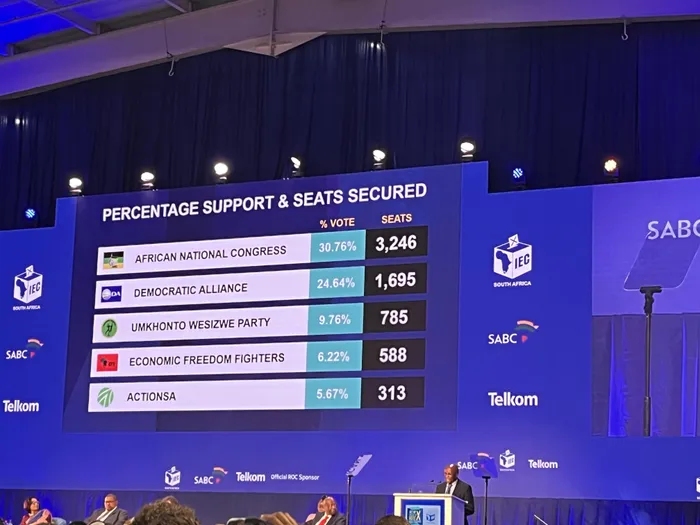
Featured image: IEC chairperson Mosotho Moepya announces the final election results. Image credit: Oluthando Keteyi (via IOL).