

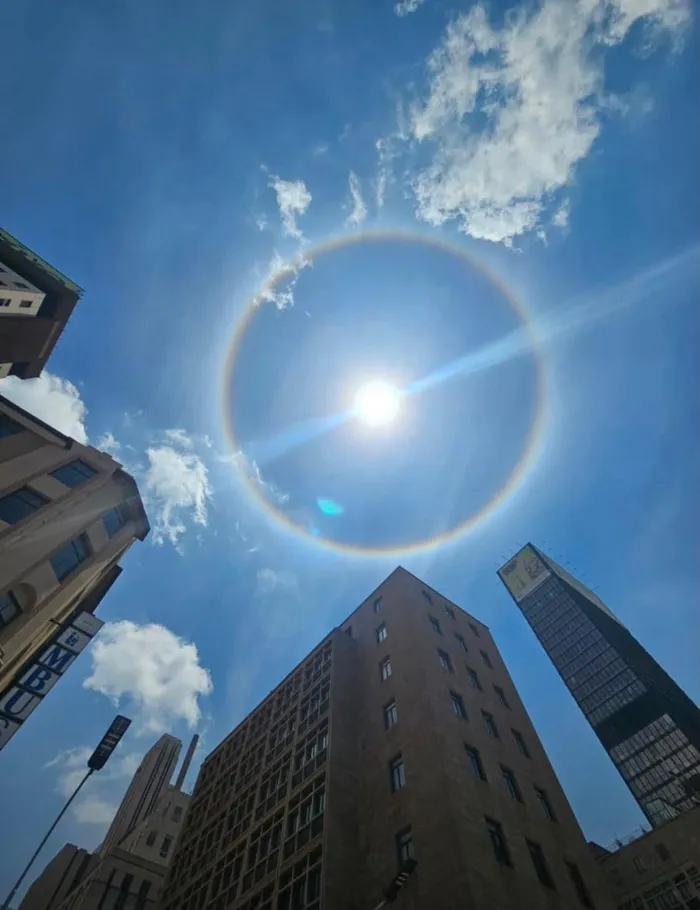
Residents in parts of Gauteng saw a bright ring around the sun on Monday, November 16. The effect is a 22-degree halo, an atmospheric optical phenomenon caused when sunlight bends through ice crystals in high-altitude clouds, the South African Weather Service (SAWS) says.
SAWS spokesperson Lehlogonolo Thobela told IOL that the crystals are found in cirrus clouds. As sunlight refracts through them at a particular angle, it forms a circular ring around the sun. The halo often looks white, though it can show colour, with red on the inner edge and blue or violet farther out. A similar effect can form around the moon.
The name refers to the approximate 22-degree angle at which the light is refracted. The standard halo can occur in any season when high ice clouds and sunlight line up, including during warmer weather; it is not limited to winter conditions.
Halos have long been associated in traditional weather lore with an approaching front or rain in the next day or so. Thobela noted that association, but the ring itself is produced by ice crystals high in the atmosphere. Its appearance alone does not establish that rain is on the way.
The Gauteng sighting followed thunderstorms and heavy rain in parts of the province on Sunday evening, according to IOL. The visible ring offered a striking reminder that familiar sunlight can produce unusual effects when cloud conditions are right.
Source: IOL / Sunday Independent, reporting by Faith Modise and comments from SAWS spokesperson Lehlogonolo Thobela.