

…as calls for justice grow
Kabelo Masoabi
A 29-year-old Peka woman, ’Makubutu Khonkhe, who was allegedly strangled by an unknown assailant and dumped in a river, has been laid to rest amid widespread public grief and growing calls for justice.
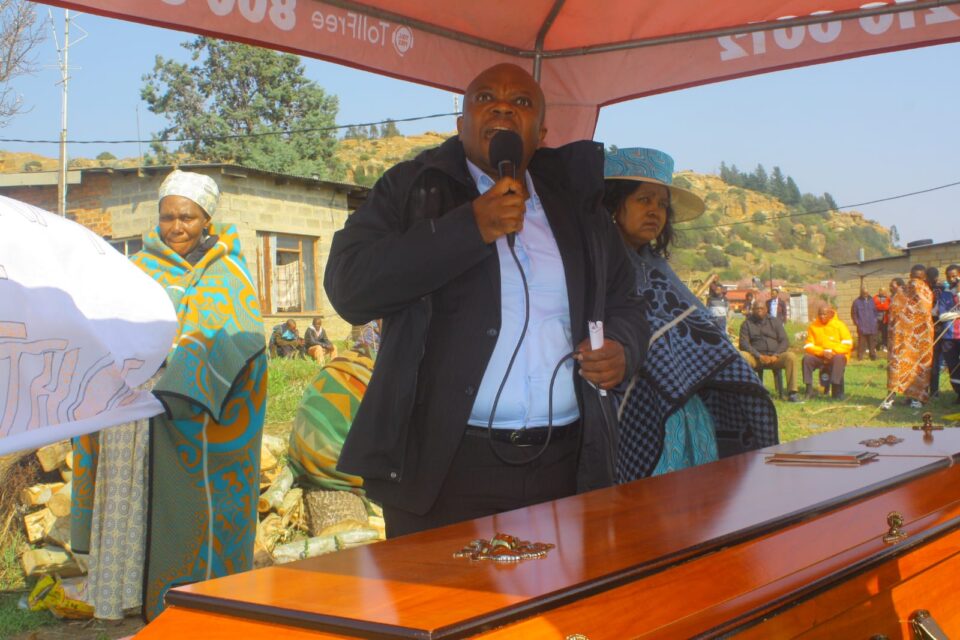
Her funeral was attended by Members of Parliament, government officials, community leaders and scores of mourners.
The Parliament Women’s Caucus pledged to do everything within its power to ensure that those responsible for her death are brought to justice.
Ms Khonkhe, of Ha-Eleke village in Peka, disappeared from her family home on the morning of 21 August. Her body was discovered the following day by herd boys who spotted what appeared to be a person lying in the middle of a river.
One of the elderly herders, Thabo Ramaqabe, said the younger boys called him after becoming too afraid to approach the object in the water.
“They told me there was something in the river and asked whether it could be a snake,” Mr Ramaqabe said.
As an experienced herder, Mr Ramaqabe said he gathered the courage to investigate. When he reached the river, he discovered that the object was the body of a woman lying in the water.
“I took off my shoes and went into the river. At first, I thought she was a shop mannequin because she is very light in complexion, but when I looked closely, I realised it was a woman. Her head was facing downwards and I noticed that she had black hair,” he said.
Mr Ramaqabe then called one of the boys to witness what he had found before they decided to alert the police. Another boy arrived and said he had heard reports of a missing woman, prompting the group to contact the local councillor, Cecelia Ntoampe.
Mr Ramaqabe said the herd boys’ decision to investigate may have ensured that Ms Khonkhe was found before the river carried her away.
“If it had not been for the herd boys, the river might have carried her away forever,” he said.
Ms Khonkhe was a new mother and had reportedly been suffering from a head-related condition. She left behind a one-month-old daughter, Senate.
Her death has also renewed attention on allegations surrounding her treatment at Berea Government Hospital, where she reportedly gave birth without assistance on 22 July.
Reports of alleged neglect by nurses at the hospital had previously brought her case into the public spotlight.
Twenty-nine days after giving birth, Ms Khonkhe was dead.
Inspector Malefane of the Criminal Investigations Division in Peka said police were deeply concerned about both the circumstances surrounding Ms Khonkhe’s death and the manner in which she died.
He praised the herd boys for their actions, saying their role in discovering the body demonstrated the important contribution they make to their communities despite often being overlooked.
When police arrived at the scene, preliminary investigations indicated that Ms Khonkhe had been strangled.
“Bad things are happening here. However, I appeal to the community not to take the law into their own hands should the suspect be apprehended,” Insp Malefane said.
The deceased’s uncle, Mohau Lipholo, said he was the one who retrieved her body from the river.
“It looked like she was raped, killed and thrown into the river,” he said.
The Peka MP, Mohopoli Monokoane, called on the police to conduct a thorough investigation into the death. He also urged the Minister of Health to launch a separate investigation into the circumstances surrounding Ms Khonkhe’s treatment at Berea Government Hospital.
Mr Monokoane said he had received a call from a relative of the deceased, Moeti Khonkhe, who told him that Ms Khonkhe’s husband had assisted her in giving birth after nurses allegedly neglected her.
“In short, the husband, Mr Matee, assisted his wife to give birth. I have heard that the nurses have been suspended from work over allegations of serious malpractice,” Mr Monokoane said during the funeral service.
Health Minister, ’Mamokete Ntšekhe, said the Ministry of Health has a responsibility to protect and save lives, but stressed that the alleged actions of individual health workers should not automatically be regarded as a failure of the entire ministry.
She said nurses should not all be judged by the actions of a few, recalling that she herself had children because of the care and assistance she received from nurses who served her with compassion and dedication.
The Minister urged members of the public with complaints about health services to approach the relevant supervisors respectfully so that their concerns can be investigated and addressed.
She warned, however, that Lesotho was already facing a serious maternal health crisis, with many women dying during childbirth, and said the situation must not be aggravated by negligence or poor service at health facilities.
The funeral also highlighted the plight of Ms Khonkhe’s one-month-old daughter, who has now been left without her mother.
Ms Ntšekhe appealed to the community to rally around the infant and ensure that she is protected, cared for and given the opportunity to survive and grow up well.
“No government money has been used to assist here; it has been done by people acting voluntarily and in good faith,” the Minister said.
Speaking on behalf of the family, Moeti Khonkhe said the place where Ms Khonkhe was found was difficult to reach and that only the herd boys were in a position to see her.
“Her left hand was raised as if she was appealing for help or resisting something,” he said.
The family also expressed gratitude to Lesotho Funeral and other stakeholders for their support during the difficult period.
“Lesotho Funeral came to our rescue during a very difficult time by generously donating the casket and providing funeral services. We are deeply grateful for their kindness, compassion and support when we needed it most,” the family said.