

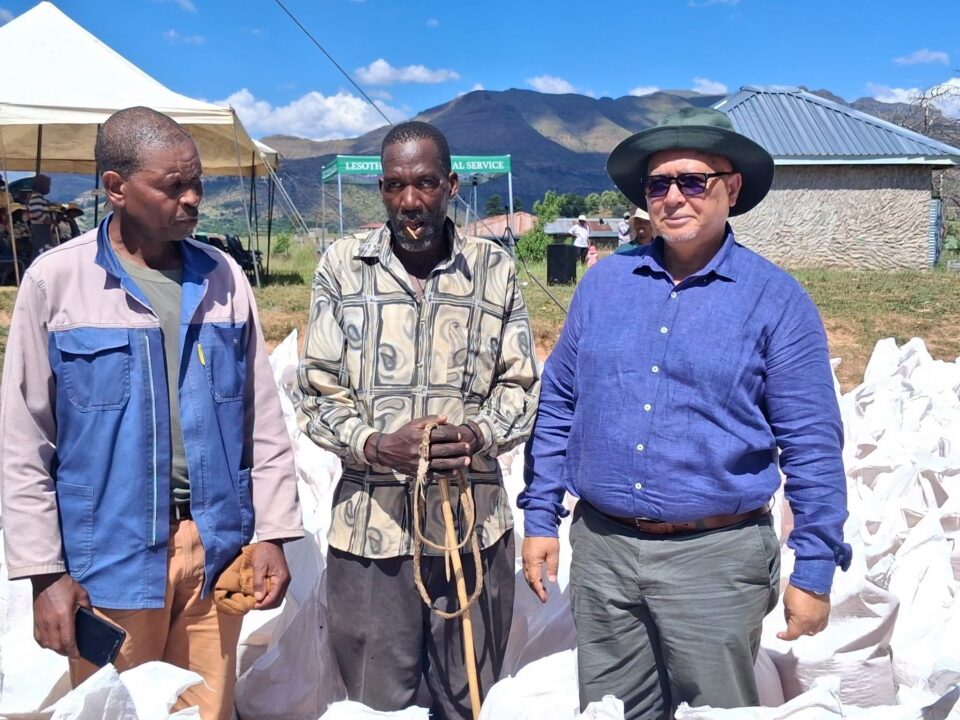
…as parties share 2380 bags of maize harvest
Ithabeleng Qhasho
THE Lesotho Correctional Service (LCS) says its bloc-farming partnership with local communities is proving successful, with the latest harvest yielding 2380 bags of maize that have been shared between the Service and participating farmers.
The initiative, which brings together the LCS and community members who make their unused fields available for cultivation, is aimed at boosting food production, reducing the government’s expenditure on inmate food and providing participating landowners with a share of the harvest.
The success of the partnership was celebrated on Thursday at Setanteng village in Mohale’s Hoek, where Minister of Law and Justice Richard Ramoeletsi distributed 2380 bags of maize to participating farmers under the arrangement.
The harvest also provided an opportunity for the LCS to respond to social media allegations that inmates were being used to work on the minister’s personal farms. It dismissed the claims, maintaining that the agricultural project was an institutional food-security initiative rather than a private undertaking.
Speaking at the handover ceremony, Assistant Commissioner Letlaka Banyane said the allegations had misrepresented the purpose and ownership of the produce.
“The post was written by you, journalists, alleging that the minister had sent inmates to work on his personal farms. I therefore wish to invite you to tour the Mohale’s Hoek facility and see for yourselves that the maize you will find there is not the minister’s personal property that he can take home and use. It is associated with him because he leads the ministry,” he said.
Mr Banyane challenged journalists to establish the facts by visiting the correctional facility and verifying the destination of the harvested maize.
He also challenged them to visit the minister’s residence to establish whether they would find bags of maize similar to those distributed to farmers, although he acknowledged that he had not personally visited the minister’s home.
A partnership that benefits both parties
Under the arrangement, the LCS, through its Self-Sufficiency Project, provides resources and inmate labour to cultivate fields made available by community members. The resulting produce is then shared between the Service and landowners in accordance with their agreement.
Mr Ramoeletsi said the partnership was designed to secure agricultural land for food production while ensuring that communities providing the fields also benefited.
He said the previous planting season had not yielded a harvest, prompting the ministry to improve its planning to avoid a repeat of that experience.
The minister said the government was working towards reducing its dependence on purchased food, revealing that it had previously been buying approximately 10,500 bags of maize annually to feed inmates countrywide.
The 2380 bags harvested in Setanteng would contribute towards meeting the LCS’s food requirements, while the agreed sharing arrangement ensured that participating farmers also received their portion.
Mr Ramoeletsi said the programme was also being implemented in Maseru and Peka in Leribe, with the ultimate objective of enabling correctional facilities to produce more of their own food.
Beyond food production, he said the initiative was an important component of inmate rehabilitation, as agricultural work equipped prisoners with practical skills they could use to earn a living after their release.
“We give them skills so that when they are released, they have the much-needed skills to live well with others,” he said.
LCS Acting Chief of Corrections, Matingoe Phamotse, said the initiative was necessary partly because the government did not own land allocated to individuals by chiefs, making partnerships with private landowners essential.
He said the Service was committed to realising the minister’s vision of self-sufficient food production and would continue working towards increasing agricultural output within correctional facilities.
Mr Phamotse also noted that Lesotho was lagging behind other Southern African countries in efforts to promote food production in prisons.
“Right now, I would also stand confidently before Africa and say I also do something towards food security,” he said.
The bloc-farming initiative, established in 2024, is also intended to ease the financial burden of feeding inmates. The minister previously told the National Assembly’s Committee of Supply that the Ministry of Law and Justice spends approximately M14 million annually on inmate food.
Communities embrace the initiative
Counsellor Tšolo Tšolo, representing the Setanteng and Maphutsing communities, said the partnership had brought relief to residents who struggled to cultivate their fields, particularly because of increasingly difficult weather conditions associated with climate change.
He said some villagers had initially been reluctant to make their fields available because they feared they might be cheated or denied their agreed share of the harvest.
However, the successful harvest had helped build confidence in the arrangement. Mr Tšolo said he had since received calls from residents who regretted not participating and were now interested in joining the programme.
Meanwhile, Growing Nations, an organisation promoting conservation agriculture, has encouraged residents of Maphutsing in Mohale’s Hoek to make their unused fields available for cultivation under the LCS-community partnership.
Speaking to the Sunday Express on the sidelines of the event, Growing Nations representative, Moliko Lekhera, said putting uncultivated fields into production could help address food shortages, particularly as climate change continued to affect agricultural activities.
He encouraged farmers to adopt drought-resistant seed varieties and modern farming methods to improve yields despite changing weather patterns.
Mr Lekhera said the government had achieved a successful harvest through its partnership with Growing Nations, which provided guidance throughout the maize production process.