

Mathatisi Sebusi
FOR generations, menstruation has quietly robbed thousands of girls in Lesotho of something many take for granted: the chance to attend school every day with confidence and dignity.
Every month, countless girls stay home from class because they cannot afford sanitary pads. Others endure embarrassment, anxiety and stigma, while some are pushed into dangerous situations simply to obtain money for basic menstrual products.
What should be an ordinary biological process has instead become a barrier to education, health and opportunity.
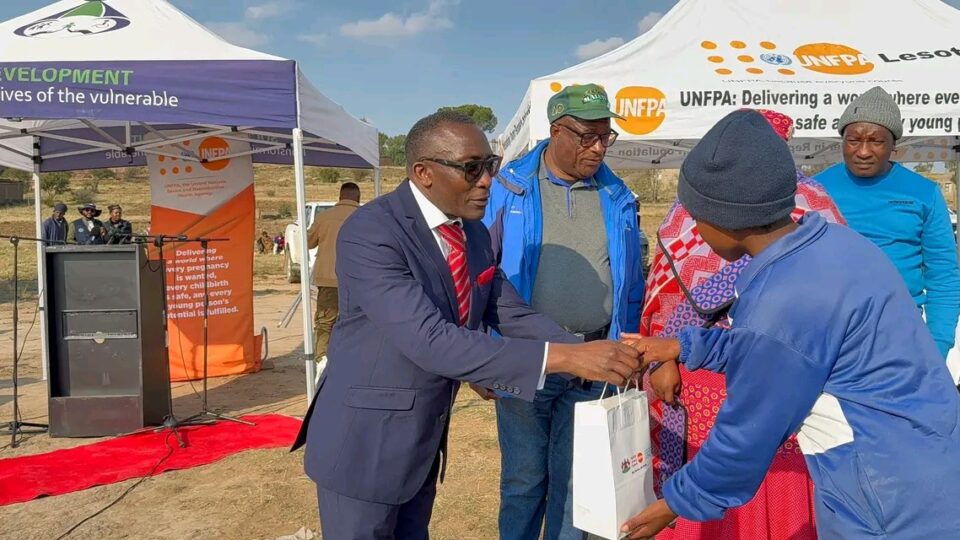
That is the reality the government and its partners hope to change through the newly launched Menstrual Health and Hygiene Model, unveiled at Ha Ralintši in Mafeteng this past weekend.
The initiative, a partnership between the Ministry of Gender, Youth and Social Development and the United Nations Population Fund (UNFPA), aims to provide free sanitary pads to thousands of girls and women in Mafeteng, Mokhotlong and Maseru.
Beyond the distribution of pads, however, the initiative seeks to address deeper challenges surrounding menstrual health, education and gender equality.
Deputy Prime Minister, Nthomeng Majara, described the programme as an investment in the dignity, health and future of girls and young women.
“This model has two pillars: the distribution of sanitary pads and education on sexual and reproductive health and rights,” Ms Makara said during the launch.
The government, she added, intends to take ownership of the initiative and eventually expand it nationwide so that menstrual health support becomes a permanent feature of public services.
The announcement comes against the backdrop of alarming statistics revealing the extent of menstrual poverty in Lesotho.
According to Minister of Gender, Youth and Social Development Pitso Lesaoana, approximately 10 percent of girls in schools and seven percent of girls in rural communities miss school during menstruation because they lack access to sanitary products.
For many families already struggling to meet basic needs, sanitary pads are often viewed as an unaffordable luxury rather than a necessity.
The consequences, however, extend far beyond missed classroom hours.
UNFPA Country Representative Kennedy Mosoti said menstrual poverty can expose girls to significant risks.
“These are not just pads; we are talking about dignity and respect for girls,” he said. “We all have a responsibility to ensure that girls maintain their dignity and continue attending school while menstruating.”
Mr Mosoti noted that some girls resort to relationships with older men to obtain money for sanitary products, placing them at risk of exploitation, sexually transmitted infections and HIV.
The links between menstrual poverty and broader social challenges are becoming increasingly evident.
Inspector Mamosa Maile of Mafeteng Police Station revealed that 73 girls reported cases of sexual abuse in 2025, while 26 cases have already been recorded this year. She believes the actual figures are likely much higher because many incidents go unreported.
“Most cases are not reported because perpetrators are often family members, and girls are discouraged from reporting the abuse,” she said.
Health statistics paint an equally concerning picture.
Nurse Lerato Challa from Mafeteng reported that HIV prevalence remains high among young people in the district. In 2025, approximately 1,328 girls were enrolled on antiretroviral treatment. During the same year, four 15-year-old girls gave birth, while 389 girls aged between 15 and 18 years and 531 young women aged between 20 and 24 years also gave birth.
She further stated that 83 girls experienced miscarriages or underwent abortions.
“These figures show that many girls are already engaging in unsafe sexual relationships,” Challa said. “There is a need for education so that girls understand that menstruation does not mean they are ready for sex.”
Recognising this need, the Menstrual Health and Hygiene Model incorporates education alongside the provision of sanitary products. Officials said boys would also be included in awareness programmes to help eliminate stigma and misconceptions surrounding menstruation.
The Minister of Finance, who is also the Member of Parliament for Qalabane Constituency, emphasised the importance of changing attitudes among boys and men.
“There is no need to humiliate girls when they are on their periods,” she said. “Instead, they should be supported and made comfortable.”
In Mafeteng alone, about 3,000 girls and women are expected to benefit from the programme this year. The sanitary pads will be distributed through five community councils and 26 schools.
For beneficiaries such as Polo Letsie, the programme represents much more than access to sanitary products.
She said a reliable supply of sanitary towels would give girls peace of mind, preserve their dignity and allow them to attend school without interruption.
She also noted that girls would no longer feel pressured to enter exploitative relationships simply to obtain money for sanitary products.
“These are not just pads; they are hope and dignity restored. We will now feel more comfortable and confident during menstruation,” she said.
While the initiative has been widely welcomed, advocates for people with disabilities said menstrual health interventions must also address their unique needs.
Refuoe Sesinyi of the Lesotho National Federation of the Disabled appealed to the government to ensure that people with disabilities are included in the programme and provided with menstrual products suited to their circumstances.
She explained that girls and women who use wheelchairs often require sanitary pants and other specialised products to manage menstruation comfortably and with dignity.
“Even though menstruation is natural, it can become a burden and a source of shame for people with disabilities because they often lack access to appropriate menstrual products,” she said.
“Many people with disabilities come from disadvantaged families and struggle to secure employment. As a result, affording proper sanitary products becomes a distant dream, and menstrual hygiene becomes a luxury instead of a basic need.
“All I ask is that this initiative also reaches communities of people with disabilities and provides resources that meet their specific needs.”
Her plea highlights an important reality: while access to sanitary products is a challenge for many girls and women, the barriers can be even greater for those living with disabilities.
As Lesotho moves to confront menstrual poverty, the initiative signals a growing recognition that menstrual health is not merely a women’s issue. It is an education issue, a public health issue and a matter of human dignity.
For thousands of girls, a simple sanitary pad could mean the difference between staying in school and dropping out, between opportunity and disadvantage, and between shame and dignity.